


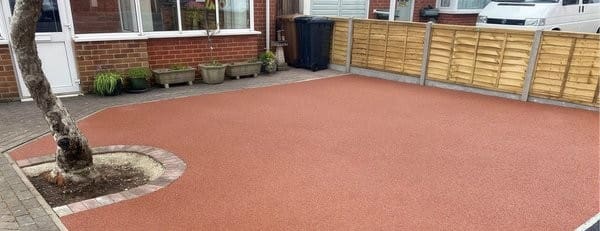
We had a call last month from a couple off Augusta Park who’d had a resin driveway put down three years back by someone else, and after every downpour it was pooling by the garage door instead of draining away. That’s exactly the kind of job that’s pushed drainage right to the top of the conversation this year — the guidance coming out in 2026 is clear that permeability, not just the finish, is what decides whether a scheme gets signed off.
Get the sub-base wrong and nothing above it matters. We’re laying open-graded MOT Type 3 at 100-150mm depending on ground conditions and traffic loading, over a geotextile membrane, so water passes straight through rather than sheeting off into the road. On a resin bound system the wearing course itself only needs to be 15-18mm, aggregate and resin trowelled to an even fall of around 1:60 so there’s no standing water without it looking like a slope.
Resin bound and resin bonded aren’t the same thing, and it’s worth knowing the difference before you commission a job. Bonded is the loose scatter finish you sometimes see gone patchy after a hard winter; bound mixes the aggregate and resin together first, which is why a properly specified, BBA-certified system on a decent sub-base should see you through 15-25 years. Material costs have crept up 8-12% over the past couple of years, so we’d always rather quote it accurately than cut corners on depth to hit a number.
We’ve been doing driveways and patios around Andover, Newbury and Basingstoke for well over 60 years as a family firm, and we’ll always tell you honestly whether resin, block paving or tarmac suits your ground before you commit. No deposit required, free quotes, and you can see examples of recent work on testvalleypaving.co.uk.